This is a Scoping Review Protocol following the JBI Scoping Review Template. Scoping Review Protocol: Review title Examining the impact leadership behaviours have on older volunteers’ engagement, influencing their satisfaction and retention in their volunteering… More

Blog

My Emerging Professional Identity
About Me
It was never my intention to become an Educator. I have always had a passion for management and people. Creating this blog is expanding my practical use of social media and technology, promoting connectivity and engagement for my Blue Mountains International Hotel Management School (BMIHMS) students. For them to be able to interact with me on a media platform for informal discussions on the study topic will provide a safe mechanism for student development (Bates, 2016, p.107). My life’s professional practices have spanned the disciples of management, hospitality and tourism operations, hotel management, and learning and development. With such time investment in business management, the leap to a formal role of educator, a Learning Facilitator, caused me both excitement and apprehension.
The student/teacher relationship in my class contributes to the classroom culture and shapes the socialisation of all active participants (Wenger, 2012, p.11). Clarke et al. (n.d.) state that student diversity, advances in technology, industry-aligned studies and part-time employment can reshape a teachers’ professional identity. How I enact my professional identity will contribute fundamentally to my style of teaching and enable the learning process (Bathmaker & Avis, 2005, p. 5).

“Learning is a social becoming” (Wenger, 2012, p.3). Active participation in class discussions enhances student engagement, promotes active learning and creates a sense of belonging amongst students (Matthews et al., 2011). Vygotsky’s Social Learning Theory (1978) states that the most significant learning occurs when students participate in group learning activities. In facing the challenges of an online learning platform and student engagement, I chose to enrol in the Graduate Certificate in Learning and Teaching (GCLT400A) to assist in both my understanding of the most effective teaching methods in adult learning, while enhancing my knowledge of learning resource design. While undertaking my MBA (2018-2020), I was allowed to explore my learning pathway of self-directed learning (Knowles, 1975; Merriam, 2001) which I found exceedingly satisfying. I want to offer this opportunity to my students.
Self-directed learning (Andragogy) taps into the Self-Determination Theory (Ryan & Deci, 2018) which states that competency, autonomy and purpose help develop students’ sense of self-efficacy and self-esteem (Blascke & Hase, 2015, p.3). Blascke and Hase (2015) explore the concept of advanced learning ecologies where learner-centric strategies encourage students to share information, developing their learning journey. This Heutagogical approach is beyond the scope of my current teaching methods but I want to introduce this thinking in my class to prepare them for future learning strategies. I want them to reflect on what they have learned and how they have learned it.

This blog has been created to share my thinking and research findings. I am challenging students to comment and participate in this space. This will stretch student participation, both in their unit of Leadership study, and in their professional self-confidence. Encouraging social connection through this medium prepares them for future workplace challenges (Harvard Business Review, 2021). This blog is intended to reflect educational skills and knowledge, aligning with the learning outcomes of GCLT400A. According to Lasky (2005), my professional identity is developed by my own and others’ expectations. And this emerging teaching identity is being shaped by my current studies which promote creative thinking, helping to facilitate my students’ learning journey and their own professional identities (Tomlinson & Jackson, 2021).

References
Bates, B. (2016). Learning Theories Simplified, and how to apply them to teaching. Sage.
Bathmaker, A. & Avis, J. (2005). Becoming a lecturer in further education in England: The construction of professional identity and the role of communities of practice. Journal of Education for Teaching: International Research and Pedagogy. https://doi.org/10.1080/02607470500043771.
Blaschke, L., & Hase, S. (2015). Heutagogy: A holistic framework for creating 21st century self-determined learners. In M.M. Kinshuk & B. Gros (Eds.), The future of ubiquitous learning: Learning designs for emerging pedagogies. Springer Verlag.
Clarke, M., Hyde A., & Drennan, J. (n.d.). Professional Identity in Higher Education. http://www.springer.com/cda/content/document/cda_downloaddocument/9789400746138-c1.pdf?SGWID=0-0-45-1343503-p174324915
Engeness, I. (2021). Developing teachers’ digital identity: towards the pedagogic design principles of digital environments to enhance students’ learning in the 21st century. European Journal of Teacher Education, 44(1), 96-114. https://doi.org/10.1080/02619768.2020.1849129
Harvard Business Press Editors, (2021, April 16). Exponential View with Azeem Azhar. How Universities Can Move Society Forward Post-Pandemic. (Season 5, Episode 20). Universities and the Innovation Landscape. (Audio Podcast). https://hbsp.harvard.edu/inspiring-minds/how-universities-can-move-society-forward-post-pandemic
Knowles, M. (1975). Self-directed learning: A guide for learners and teachers. Association Press.
Lasky, S. (2005). A sociocultural approach to understanding teacher identity, agency and professional vulnerability in a context of secondary school reform. Teaching and Teacher Education, 21(8), 899-916. https://doi.org/10.1016/j.tate.2005.06.003
Matthews, K., Andrews, V., & Adams, P. (2011). Social learning spaces and student engagement. Higher Education Research & Development, 3(2), 105-120. https://doi.org/10.1080/07294360.2010.512629
Merriam, S. B. (2001). Andragogy and self-directed learning: Pillars of adult learning theory. New Directions for Adult and Continuing Education, 89. Jossey-Bass.
Ryan, R, & Deci, E. (2000). Self-determination theory and the facilitation of intrinsic motivation, social development, and well-being. American Psychologist, 55(1), 68-78.
Tomlinson, M, & Jackson, D. (2021). Professional identity formation in contemporary higher education students. Studies in Higher Education, 46(4), 885-900. https://www.tandfonline.com/doi/abs/10.1080/03075079.2019.1659763?journalCode=cshe20
Wenger, E. (2012). Communities of practice and social learning systems: The career of a concept. https://wenger-trayner.com/wp-content/uploads/2012/01/09-10-27-CoPs-and-systems-v2.01.pdf
Figure 1 Lev Vygotsky (image). (n.d.) iz.quotes.com, https://izquotes.com/author/19414
Figure 2 Photo of a plaque on my desk. (2021)

Reflection in Practice
“You don’t know what you don’t know!”. Studying the Graduate Certificate in Learning and Teaching (GCLT) has imbued me with such enthusiasm in my role as a Learning Facilitator, while constantly alerting me to the huge gap in my knowledge as an online teacher. This course has been well scaffolded to lead me down a path of exciting self-discovery, guiding improved teaching methods. In this reflective journal, I will explore how my current studies have explained my frustrations in my academic journey over the years. Being able to critically evaluate my own experiences has enabled me to assist my students to self-reflect on their learning journeys (Schon, 1987. p. 28).
With several academic qualifications, there was an assumption that I would be a skilled teacher. My qualifications and career experience predicted that I was a content specialist and hence I was given the role of a Learning Facilitator (LF), delivering at Master’s degree level. Although I struggled with a lack of student engagement in my online classes, I was reassured by other LFs that these frustrations were normal and experienced by others. It was not until I commenced the GCLT that I realised that guiding frameworks in Learning Theories are essential to teaching practices (Schunk, 2012, p.20). My discovery process, through well-constructed scaffolding of the different learning theories, has created a sense of excitement in my learning journey. To date, my exploration of the Community of Inquiry (CoI) framework has had greatest impact on my thinking (Garrison et al., 2000). This framework is based on the belief that a community of learners is essential for a meaningful educational experience. It identifies the fundamental elements to this experience as being teaching presence, cognitive presence, and social presence (Garrison et al., 2000). As an online student throughout my working career, generally, text resources were provided, and self-guided motivation was expected to “get you through”. This was a challenging way to learn and not always very fulfilling. I attributed my varying degree of learning engagement to the presence, or lack thereof, of a motivating teacher. I now see this as very one-dimensional thinking. Teacher Presence (CoI) is vital where instructional management builds understanding, provides facilitation and direct instruction (Garrison et al..2000). However, as identified by Dr Patrick Lowenthall (2014), an enhanced level of Social Presence is also required for high-level learning to occur. Richardson and Swan (2003) undertook a study, identifying students with high perceptions of social presence who scored high in perceived learning and satisfaction with the instructor. This social presence element underpins student self-identity, emotional expression, open communication, and the development of group cohesion (Fiock, 2020. p. 138). Identifying my past feeling of online isolation has informed my teaching to actively connect with my students through several technologies. That personal engagement of storytelling, informal personal videos, quick response emails, one on one live chats, regular feedback couched in positive language, and ensuring a safe class environment, have been a part of my teaching design because of my recent studies. Incorporating social aspects of learning in the instructional design is really putting connectivism principles in place (Siemens, 2005). With embarrassment, I reflect on my behaviourist style of lecturing, “Sage on the Stage” in my first terms of teaching.
Technology with Social Connection
Having worked extensively in training in a large workplace environment, I discovered that employees with learning difficulties flourished in an environment where they felt safe and valued. The Community of Inquiry elements (Garrison et al., 2000) and Pittaway’s (2012) Engagement Framework (personal engagement, academic engagement, intellectual engagement, social engagement, and professional engagement) bring our focus on how students engage with their learning and the role teachers play in this interface. Pittaway (2012, p. 40) states that for students to engage, staff must also be engaged. Turning this to my teaching presence, I have wanted to research if increased use of technologies, such as Menti.com. Kahoot or Socrative would improve the learning outcomes of my students. Could my increased use of technology connect me to my younger cohort, resulting in increased engagement? Anecdotally, after including these in some classes, there was increased participation, but this was evidenced in only one student cohort in one term. With this class, I also explored the metacognitive learning principles (Flavell, 1979), where I involved the students in my own Graduate Certificate study, encouraging them to reflect on their own learning and “thinking about thinking”. As predicted in the Community of Inquiry Model, cognition is sustained when there is a high level of social presence (Garrison et al., 2000). Through this activity, I experienced increased student participation and engagement.
Often half of my class cohort are based in their home country. The role that social and cultural factors have on adult learning (Constructivism, Vygotsky, 1978) has encouraged my teaching inquiry further. Breakout chat rooms, informal videos, a personal blog and group discussion activities have partnered my class instruction. Through active participation in my Community of Practice, plus active learning in class discussions, I progressed my thinking from identifying a piece of technology that is expected to be used, to aligning that technology to the required learning outcomes. The SAMR Model and TPACK have provided the “how” to the reason why certain activities work. Starkey (2011) explores connection and collaboration, creativity, and critical thinking as key in developing a digital age learning matrix. This work identifies that learning through connections and sharing ideas are important aspects for emerging knowledge. Exploring creative teaching methods, I have tried to involve the students in exploring technology to further their learning outcomes, as described in the SAMR model. I have noted in my classes that inviting students to demonstrate their technological ability to their colleagues enhanced their engagement and self confidence in that learning environment as predicted in Siemen’s Connectivist Learning Theory (2004). This illustrates how the sharing of ideas, the collaboration, the Social Presence works for learning engagement (Starkey, 2011). Stabile (2014) focuses on how educators should have professional conversations on how learning occurs rather than how one teaches. He suggests the engagement of a self-discovery approach to student learning. Siemens (2010) suggests teachers use current technology for its authentic functionality, promoting connected learning transparency and narrative coherence. By introducing a flipped classroom model, using technology to encourage self-guided learning, I have been able to encourage student confidence and independence in a collaborative environment.
Conclusion
I find there is a recurring theme in my literature review of the need for classroom collaboration and social connection to achieve online student engagement. In the Community of Inquiry model (Garrison et al., 2000), Pittaway’s Engagement Framework (2012), and the Online Engagement Framework (Redmond et al., 2018), each connects with a humanistic approach to learning where relationships, emotions and self-evaluation are recognised components to achieve successful student learning outcomes. My question for future inquiry is do we need to foster increased emotional intelligence in teachers to augment social presence in online teaching environments?
References
Fiock, H. (2020). Designing a community of inquiry in online courses. The International Review of Research in Open and Distributed Learning, 21(1), 135–153. http://www.irrodl.org/index.php/irrodl/article/view/3985
Flavell, J. (1979). Metacognition and cognitive monitoring: a new area of cognitive developmental inquiry. American Psychologist 34, 906-911.
Garrison, D, Anderson, T., & Archer, W. (2000). Critical inquiry in a text-based environment: Computer conferencing in higher education. The Internet and Higher Education 2.2/3, 87-105.
Pittaway, S. (2012). Student and Staff Engagement: Developing an Engagement Framework in a Faculty of Education. Australian Journal of Teacher Education, 37(4). https://ro.ecu.edu.au/ajte/vol37/iss4/3/
Redmond, P., Abawi, L., Brown, A., Henderson, R., & Heffernan, A. (2018). An online engagement framework for higher education. Online learning, 22(1), 183–204. https://files.eric.ed.gov/fulltext/EJ1179626.pdf https://lesa.on.worldcat.org/oclc/7428906801
Richardson, J., & Swan, K. (2003). Examining social presence in online courses in relation to students’ perceived learning and satisfaction. Journal of Asynchronous Learning Networks, 7(1), 68−88. doi:10.1016/j.chb.2017.02.001
Schon, D. 1987. Educating the Reflective Practitioner. Toward a new design for teaching and learning in the professions. Jossey-Bass Publishers.
Schunk, D. (2012). Learning Theories: An educational perspective. 6th edition. Pearson.
Siemens, G. (2005). Connectivism: A learning theory for the digital age. International Journal of Instructional Technology and Distance Learning, 2(1). http://www.itdl.org/journal/Jan_05/article01.htm.
Siemens, G. (2010, March 6). TEDxNYED – George Siemens – 03/06/10. https://www.youtube.com/watch?v=4BH-uLO6ovI
Stabile, C. (2014). Promoting Change Through Active Faculty Enrichment: A Shift in the Mindset of Faculty Educators from Teacher-Centered to Learner-Centered. Innovative solutions to contemporary challenges, Language teaching and TEFL professional development in Nicaragua, The Nicaraguan English Language Learning Journal. https://www.generalsemantics.org/product/etc-a-review-of-general-semantics-71-3-july-2014/
Starkey L. (2011). Evaluating learning in the 21st century: A digital learning matrix. Technology, Pedagogy and Education. 20(1),19-39.
Vygotsky, L. S. (1978) Mind in Society: The Development of Higher Psychological Processes (M. Cole, V. John-Steiner, S. Scribner, & E. Souberman, Eds.) Cambridge, MA: Harvard University Press.
Reflection in Practice
Educational Theories and Principles
My Key Learning and Teaching Outcomes
As part of the theory of Andragogy, Knowles (1988, p.48-49) highlights the role of experience and the necessary involvement of the learner in the education process. The desire for self-direction and the readiness to learn were explored in his early work (Knowles, 1988, p.43). One of the key concepts he researched was how teachers could help students apply new learning to their prior life experience, making the learning more meaningful (Knowles, 1988, p.72). As far back as 1938, Dewey also stated that using students’ experience would be a useful tool for teaching (Dewey, 1938). Encouraging my students to discuss their past leadership or management roles helps to bring a meaningful, practical context to our class discussions. This blog post explores how educational theories and principles that inform my teaching practices.
Safe Learning
It is of great importance for the learning facilitator to identify the developmental stages of the class students. Piaget, one of the most influential Cognitive Theorists, identified four stages of learners’ development (Bates, 2016, p.48). While Piaget’s work focused on children, his theories are equally applicable to adults. Respecting learners’ interests and abilities is pivotal to creating an effective learning environment (Powell & Kalina, 2009, p. 243). Piaget’s Cognitive Constructivism Theory recognizes that this student-centric focus, as does Vygotsky’s Social Constructivism Theory (1934). This theory states that student interactions encourage critical thinking processes (Powell & Kalina, 2009, p. 244). Both theories focus on learners reaching their full potential. Fundamental aspects of Vygotsky’s theory are the Zone of Proximal Development (ZPD): identification of the learners’ s understanding and subsequent teacher support requirement; and Scaffolding: stepped collaboration with teacher guidance. In my role as a Learning Facilitator, creating a safe learning environment, where student contributions are recognized, supported and guided, are vital in this online environment.
Transformational Learning
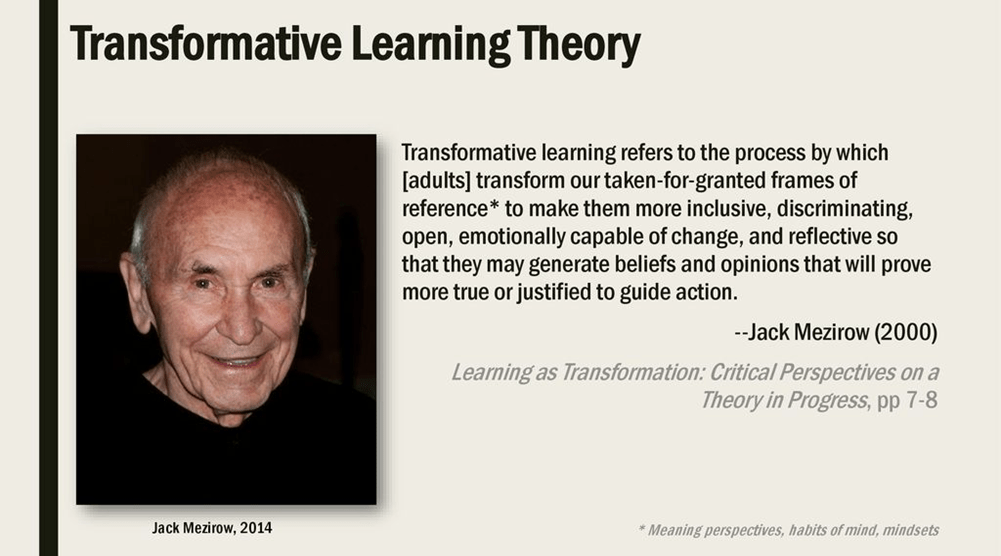
Mezirow and Brookfield were interested in conscious changes in the learner (Miklos & Noordegraaf-Eelens, 2021, p.152), as a part of their theory of Social Transformative education. It is the educator’s responsibility to foster student autonomy and responsible thinking (Mezirow, 1997, p.8). He goes onto state that effective discourse as a social process promotes meaningful learning. Critical reflection and discussion can produce a paradigm change, encouraging transformational learning (Mezirow, 1997, p.11). In my teacher/student relationship through the teaching term, I guide the learning towards personal development, initiating behaviours that can generate change or transformation in students’ leadership outlook. As opposed to Behaviourist teaching methods (Skinner, 1953), Transformative Learning is an internal process, and the teacher’s role is to provide opportunities for learning in a conducive environment (Illeris, 2015, p.2). I intend to provoke my students into an awareness of how they learn and what they want to achieve, both in their personal and professional identity. That is my intention. This blog may provide a tool to gauge my success or otherwise.
Active Learning
Cognitive Theorists have explored student-centric learning since the 1950s. Active Learning or Interactive learning (Lambert, 2012) is described as learners taking new information and applying it. Eric Mazur, a Harvard lecturer, undertook several studies to prove that the students who collaboratively engaged with their colleagues were the most successful performers (Lambert, 2012). Breslow (n.d.) emphasizes that students should not be passive recipients of information but need to be engaged learners. In my classroom, I encourage students not to be passive in their search of knowledge, but to be curious in their research activities. My role is that of a mentor or coach.
Aligned Learning
Constructive Alignment is a concept around students constructing their learning through relevant learning activities (Biggs,1996, p. 351). It uses Constructivism as a framework of learning outcomes to shape teaching design and assessments. Biggs (1996, p. 353) goes on to discuss Teaching/Learning Activities (TLAs) that can be addressed outside of the lecture. Encouraging the concept of both teacher and students participating in the process of activity construction provides a framework for learning outcomes (Biggs, 1996, p.343). In truth, my teaching environment has not progressed this far although some students are happy to be prompted to source new learning resources. This is a work in progress as I see outstanding benefits to Bigg’s (1996) practical suggestions in TLAs.
Connected Learning
Connectivism embraces technology in the learning process. With our tech-savvy students today, preparing for the workplace in the 21st century, utilising social media and technology are imperative. George Siemens proposed this learning theory for our digital age, stating that knowledge has been set free to create a dynamic learning environment (Siemens, 2006, p. 11). With technologies advancing exponentially, it is our responsibility as teachers to expose our students to a positive uptake of these information technologies. Hence my enthusiasm to embrace this blog tool.

References
Bates, B. (2016). Learning Theories Simplified, and how to apply them to teaching. Sage Publications.
Breslow, L. (nd). New Research Points to the Importance of Using Active Learning in the Classroom. Teach Talk – Massachusetts Institute of Technology. http://web.mit.edu/fnl/vol/121/breslow9.htm
Biggs, J. (1996). Enhancing teaching through constructive alignment, Higher Education, 32(3). https://doi.org/10.1007/BF00138871
Dewey, J. (1938). Experience and Education. Collier Books.
Illeris, K. (2015). Transformative learning in higher education. Journal of Transformative Learning, 3(1), 46-51.
Knowles, M. (1988). The Adult Learner. A neglected species. Gulf Publishing.
Lambert, C. (2012). Twilight of the lecture: The trend toward “active learning” may overthrow the style of teaching that has ruled universities for 600 years. Harvard Magazine. http://harvardmagazine.com/2012/03/twilight-of-the-lecture
Lasky, S. (2005). A sociocultural approach to understanding teacher identity, agency and professional vulnerability in a context of secondary school reform. Teaching and Teacher Education, 21(8), 899–916. https://www.sciencedirect.com/science/article/abs/pii/S0742051X0500079X doi:10.1016/j.tate.2005.06.003.
Mezirow, J. (1997). Transformative learning: theory to practice. New Directions for Adult and Continuing Education, 74(5), 12. https://doi.org/10.1002/ace.7401
Miklos, V. & Noordegraaf-Eelens, L. (2021). Toward social-transformative education: an ontological critique of self-directed learning, Critical Studies in Education, 62(2),147-163. https://doi.org/10.1080/17508487.2019.1577284
Piaget, J. (1953). The origins of intelligence in children. Basic Books.
Powell, K. & Kalina, C. (2009). Cognitive and Social Constructivism: Developing tools for an effective classroom. Education, 130(2).
Siemens, G. (2006). Learning in synch with life: new models, new processes. Google Training Summit.
Skinner, B. (1953). Science and Human Behaviour. Free Press.
Vasileva, O., & Balyasnikova, N. (2019). (Re)Introducing Vygotsky’s Thought: From Historical Overview to Contemporary Psychology. Frontiers in psychology, 10, 1515. https://doi.org/10.3389/fpsyg.2019.01515
Vygotsky, L.S. (1934). Thought and language. MIT Press.
Wenger, E. (2012). Communities of practice and social learning systems: The career of a concept. https://wenger-trayner.com/wp-content/uploads/2012/01/09-10-27-CoPs-and-systems-v2.01.pdf
Figure 1. Jack Mezirow, 2014. Transformative Learning Basic PPT. Slideplayer.com. https://slideplayer.com/slide/14578093/
Figure 2. Think, Idea, Try, Do, Do again, and again , keeping doing, Success. busy.com. Pinterst https://www.pinterest.ca/pin/686095324473891034/

My Online Learning Community
A Learning Community of Practice
Lave and Wenger (1991) likened apprenticeships to the establishment of Communities of Practice (CoP), defining them as a network of people that share an interest, who work together to find better ways to do things through regular contact (Bathmaker & Avis, 2005). This social context is important as it creates a supportive environment with member participation. Through this engagement, the members experience meaningful learning as it is the framework for a social learning system (Wenger, 2010). He goes on to say that a person’s concept of their professional identity is a central element of the creation of a CoP. Members look to define competence, experience and knowledgeability in that practice.
In our Graduate Certificate Learning and Teaching class context, we are participating in a CoP for education and professional development. Our discussions potentially can influence new thinking, redesign of resources and teaching tools (Wenger, 2010). My engagement with my CoP has been limited but enlightening. Two areas of engagement – discussion threads and Collaborate meetings – have linked our CoP or our Community of Learning. With a range of highly qualified lecturers, I immediately learned to respectfully listen to others as they are much more experienced in various academic spaces. The two meetings undertaken brought up questions in technology and assessment concerns. Genuine sharing of ideas and competencies was evident, creating a memorable experience. I now understand that learning from my peers is very effective, as stated in Lave and Wenger’s work (1991). Teacher feedback is also formative in our CoP. However, while participation is voluntary, member commitment is necessary for this CoP to be termed successful. Hassan and Crawford (2003) wrote a most interesting paper analyzing success factors of communities of learning. Their main findings were that there needed to be a specific activity for the group focus; trust needed to be established; and the purpose of the community needed to be clear. Our class CoP to date provides a genuine sense of emotional support between the members but I feel that participation would improve if we revisited the purpose and activities to be achieved. With future studies ahead, the benefit of CoP knowledge sharing spurs me on to persist in weekly meetings.
In contrast, as a member of Torrens University, I am also included as a member of the CoP of the Learning and Teaching team. Being more of a newcomer to this space, I have experienced academic support, evidenced role models in online teaching methods, experienced social connection, stretching my academic knowledge. I intend that in creating this blog, as well as other learning activities, I will engender my own student CoP.

References
Bathmaker, A. & Avis, J. (2005). Becoming a lecturer in further education in England: The construction of professional identity and the role of communities of practice. Journal of Education for Teaching: International Research and Pedagogy, 31(1), 47-62. https://doi.org/10.1080/02607470500043771.
Hasan, H., & Crawford, K. (2003). A Multifaceted Approach to Distributed Communities of Learning and
Practice, Organizational information systems in the context of globalization. 37-47. https://ro.uow.edu.au/commpapers/2873
Kenyon, C. & Hase, S. (2001). Moving from Andragogy to Heutagogy in Vocational Education. Research to Reality: Putting VET Research To Work. https://eric.ed.gov/?id=ED456279
Lave, J. and Wenger, E. (1991). Situated Learning: Legitimate Peripheral Participation. Cambridge University Press.
Wenger E. (2010). Communities of Practice and Social Learning Systems: the Career of a Concept. In C. Blackmore (Ed), Social Learning Systems and Communities of Practice. Springer, London. https://doi.org/10.1007/978-1-84996-133-2_11
Figure 1. Learning is a collaborative process depositphotos.com image ID 253593684. https://depositphotos.com/253593684/stock-photo-group-people-sitting-circle-chairs.html
 My Learning Journey