My Key Learning and Teaching Outcomes
As part of the theory of Andragogy, Knowles (1988, p.48-49) highlights the role of experience and the necessary involvement of the learner in the education process. The desire for self-direction and the readiness to learn were explored in his early work (Knowles, 1988, p.43). One of the key concepts he researched was how teachers could help students apply new learning to their prior life experience, making the learning more meaningful (Knowles, 1988, p.72). As far back as 1938, Dewey also stated that using students’ experience would be a useful tool for teaching (Dewey, 1938). Encouraging my students to discuss their past leadership or management roles helps to bring a meaningful, practical context to our class discussions. This blog post explores how educational theories and principles that inform my teaching practices.
Safe Learning
It is of great importance for the learning facilitator to identify the developmental stages of the class students. Piaget, one of the most influential Cognitive Theorists, identified four stages of learners’ development (Bates, 2016, p.48). While Piaget’s work focused on children, his theories are equally applicable to adults. Respecting learners’ interests and abilities is pivotal to creating an effective learning environment (Powell & Kalina, 2009, p. 243). Piaget’s Cognitive Constructivism Theory recognizes that this student-centric focus, as does Vygotsky’s Social Constructivism Theory (1934). This theory states that student interactions encourage critical thinking processes (Powell & Kalina, 2009, p. 244). Both theories focus on learners reaching their full potential. Fundamental aspects of Vygotsky’s theory are the Zone of Proximal Development (ZPD): identification of the learners’ s understanding and subsequent teacher support requirement; and Scaffolding: stepped collaboration with teacher guidance. In my role as a Learning Facilitator, creating a safe learning environment, where student contributions are recognized, supported and guided, are vital in this online environment.
Transformational Learning
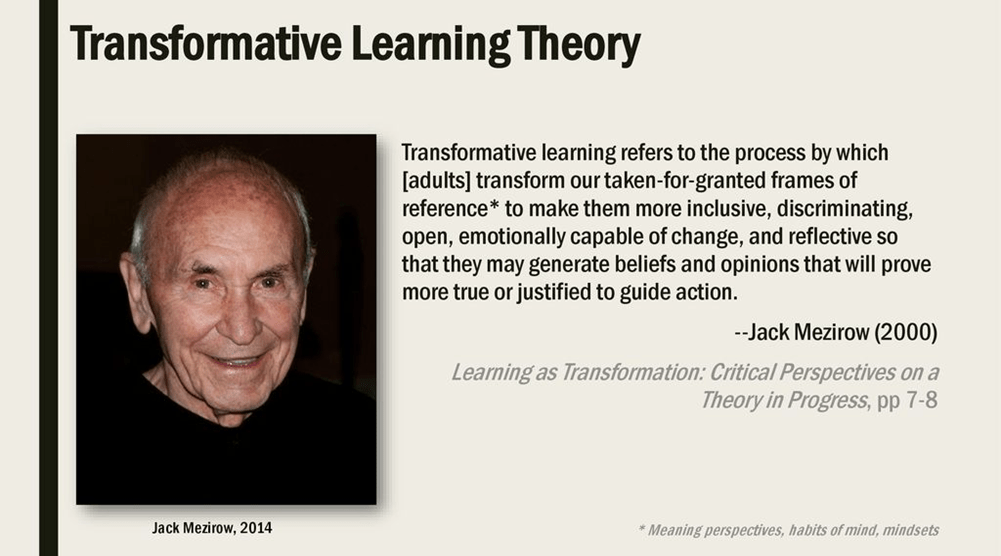
Mezirow and Brookfield were interested in conscious changes in the learner (Miklos & Noordegraaf-Eelens, 2021, p.152), as a part of their theory of Social Transformative education. It is the educator’s responsibility to foster student autonomy and responsible thinking (Mezirow, 1997, p.8). He goes onto state that effective discourse as a social process promotes meaningful learning. Critical reflection and discussion can produce a paradigm change, encouraging transformational learning (Mezirow, 1997, p.11). In my teacher/student relationship through the teaching term, I guide the learning towards personal development, initiating behaviours that can generate change or transformation in students’ leadership outlook. As opposed to Behaviourist teaching methods (Skinner, 1953), Transformative Learning is an internal process, and the teacher’s role is to provide opportunities for learning in a conducive environment (Illeris, 2015, p.2). I intend to provoke my students into an awareness of how they learn and what they want to achieve, both in their personal and professional identity. That is my intention. This blog may provide a tool to gauge my success or otherwise.
Active Learning
Cognitive Theorists have explored student-centric learning since the 1950s. Active Learning or Interactive learning (Lambert, 2012) is described as learners taking new information and applying it. Eric Mazur, a Harvard lecturer, undertook several studies to prove that the students who collaboratively engaged with their colleagues were the most successful performers (Lambert, 2012). Breslow (n.d.) emphasizes that students should not be passive recipients of information but need to be engaged learners. In my classroom, I encourage students not to be passive in their search of knowledge, but to be curious in their research activities. My role is that of a mentor or coach.
Aligned Learning
Constructive Alignment is a concept around students constructing their learning through relevant learning activities (Biggs,1996, p. 351). It uses Constructivism as a framework of learning outcomes to shape teaching design and assessments. Biggs (1996, p. 353) goes on to discuss Teaching/Learning Activities (TLAs) that can be addressed outside of the lecture. Encouraging the concept of both teacher and students participating in the process of activity construction provides a framework for learning outcomes (Biggs, 1996, p.343). In truth, my teaching environment has not progressed this far although some students are happy to be prompted to source new learning resources. This is a work in progress as I see outstanding benefits to Bigg’s (1996) practical suggestions in TLAs.
Connected Learning
Connectivism embraces technology in the learning process. With our tech-savvy students today, preparing for the workplace in the 21st century, utilising social media and technology are imperative. George Siemens proposed this learning theory for our digital age, stating that knowledge has been set free to create a dynamic learning environment (Siemens, 2006, p. 11). With technologies advancing exponentially, it is our responsibility as teachers to expose our students to a positive uptake of these information technologies. Hence my enthusiasm to embrace this blog tool.

References
Bates, B. (2016). Learning Theories Simplified, and how to apply them to teaching. Sage Publications.
Breslow, L. (nd). New Research Points to the Importance of Using Active Learning in the Classroom. Teach Talk – Massachusetts Institute of Technology. http://web.mit.edu/fnl/vol/121/breslow9.htm
Biggs, J. (1996). Enhancing teaching through constructive alignment, Higher Education, 32(3). https://doi.org/10.1007/BF00138871
Dewey, J. (1938). Experience and Education. Collier Books.
Illeris, K. (2015). Transformative learning in higher education. Journal of Transformative Learning, 3(1), 46-51.
Knowles, M. (1988). The Adult Learner. A neglected species. Gulf Publishing.
Lambert, C. (2012). Twilight of the lecture: The trend toward “active learning” may overthrow the style of teaching that has ruled universities for 600 years. Harvard Magazine. http://harvardmagazine.com/2012/03/twilight-of-the-lecture
Lasky, S. (2005). A sociocultural approach to understanding teacher identity, agency and professional vulnerability in a context of secondary school reform. Teaching and Teacher Education, 21(8), 899–916. https://www.sciencedirect.com/science/article/abs/pii/S0742051X0500079X doi:10.1016/j.tate.2005.06.003.
Mezirow, J. (1997). Transformative learning: theory to practice. New Directions for Adult and Continuing Education, 74(5), 12. https://doi.org/10.1002/ace.7401
Miklos, V. & Noordegraaf-Eelens, L. (2021). Toward social-transformative education: an ontological critique of self-directed learning, Critical Studies in Education, 62(2),147-163. https://doi.org/10.1080/17508487.2019.1577284
Piaget, J. (1953). The origins of intelligence in children. Basic Books.
Powell, K. & Kalina, C. (2009). Cognitive and Social Constructivism: Developing tools for an effective classroom. Education, 130(2).
Siemens, G. (2006). Learning in synch with life: new models, new processes. Google Training Summit.
Skinner, B. (1953). Science and Human Behaviour. Free Press.
Vasileva, O., & Balyasnikova, N. (2019). (Re)Introducing Vygotsky’s Thought: From Historical Overview to Contemporary Psychology. Frontiers in psychology, 10, 1515. https://doi.org/10.3389/fpsyg.2019.01515
Vygotsky, L.S. (1934). Thought and language. MIT Press.
Wenger, E. (2012). Communities of practice and social learning systems: The career of a concept. https://wenger-trayner.com/wp-content/uploads/2012/01/09-10-27-CoPs-and-systems-v2.01.pdf
Figure 1. Jack Mezirow, 2014. Transformative Learning Basic PPT. Slideplayer.com. https://slideplayer.com/slide/14578093/
Figure 2. Think, Idea, Try, Do, Do again, and again , keeping doing, Success. busy.com. Pinterst https://www.pinterest.ca/pin/686095324473891034/


I always enjoy reading and being reminded about the theories behind engaging learners through connected, aligned, active and transformative learning and through safe guidance, well planned, supported, collaborative approach. A great read, thanks for sharing Tracy.
Liz Lotter
LikeLike